In today’s parcel environment, data is everywhere. Dashboards are full. Reports are automated. Visibility is no longer the problem.
The real question is this: what are you doing with that data before the next decision has to be made?
For logistics and supply chain leaders, the gap between insight and action is where margin is won or lost. Traditional business intelligence tools can tell you what happened. They can even help you understand why. But when it comes to planning what to do next, especially in a volatile carrier landscape, reporting alone is not enough.
This is where parcel modeling and simulation are becoming essential.
The Limits of Traditional BI in Parcel Operations
Most BI tools were built for reporting, not decision validation.
They aggregate historical data, visualize trends, and surface performance metrics. That has value, especially for understanding spend, service levels, and carrier performance over time. But when a new carrier proposal lands on your desk or a general rate increase is announced, those same tools fall short.
They cannot answer questions like:
- What will this new contract actually cost us across our full shipping profile?
- How will shifting volume between carriers impact both cost and delivery performance?
- Where are accessorials going to increase, and how much will they affect margin?
- What happens if we add a regional carrier into our network next quarter?
Without the ability to simulate these scenarios, teams are left making decisions based on partial data, assumptions, or static snapshots. That leads to reactive strategies and missed opportunities.
The Shift Toward Scenario-Based Decision Making
Parcel operations are no longer static. Carrier pricing changes frequently. Service performance fluctuates. New carriers enter the market. Customer expectations continue to rise.
In this environment, leaders need to move from looking backward to planning forward.
Scenario modeling enables that shift.
Instead of asking what happened last quarter, you can ask:
- What will happen if we accept this carrier proposal?
- How will our cost per package change if volume increases by 15 percent?
- What is the financial impact of reducing reliance on a single national carrier?
- How do surcharge changes affect our most common shipment profiles?
These are not theoretical questions. They are daily decisions for both shippers and 3PLs managing complex parcel networks.
With the right modeling capabilities, those decisions can be tested before they are implemented.
Modeling the Variables That Actually Drive Parcel Spend
Parcel pricing is complex for a reason. Base rates are only one piece of the equation.
Real cost is driven by a combination of factors including zone distribution, package characteristics, service levels, fuel surcharges, and a growing list of accessorial fees. Add in contract incentives, minimum charges, and peak surcharges, and the picture becomes even more complicated.
Effective parcel modeling needs to account for all of it.
That includes:
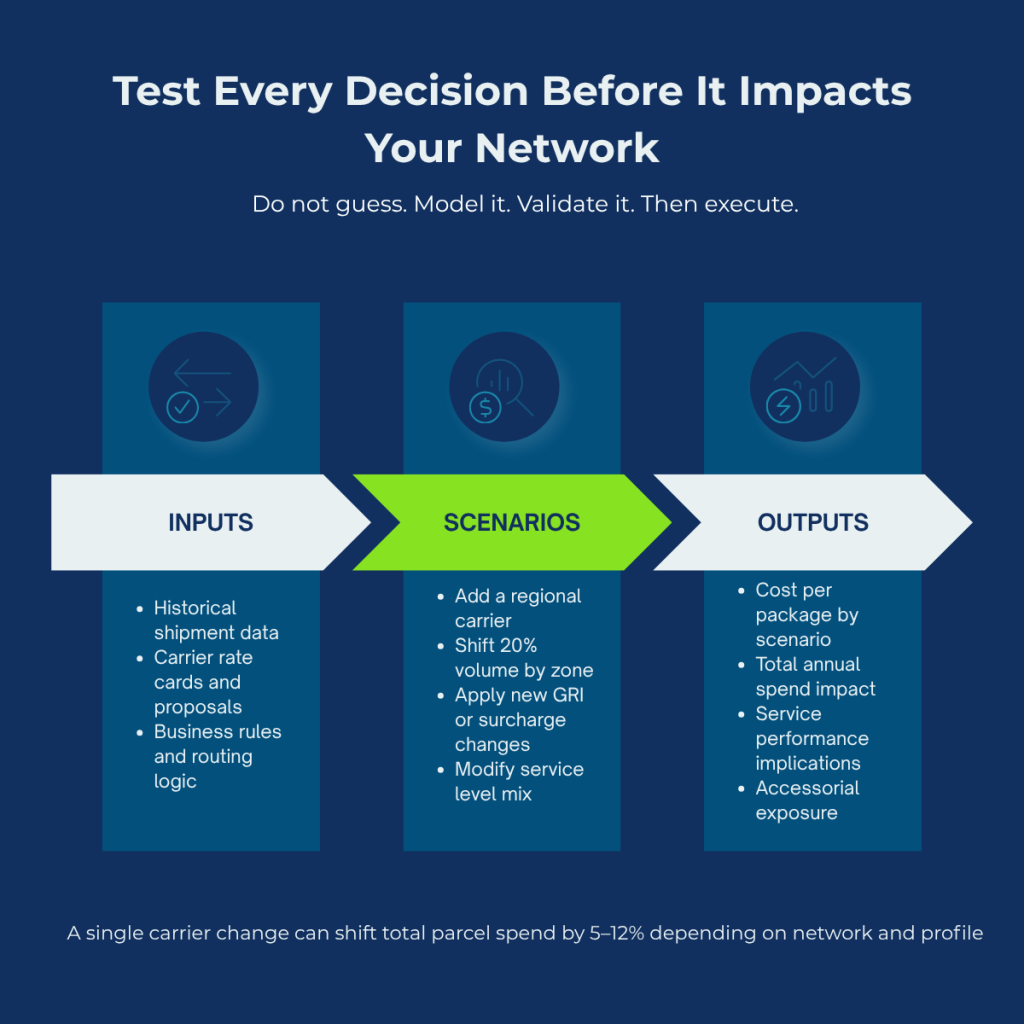
- Carrier proposals with full rate card logic and incentives
- Volume shifts across carriers, services, and facilities
- General rate increases and peak season adjustments
- Accessorial and surcharge behavior based on shipment attributes
- Operational rules that govern how shipments are routed and fulfilled
This is where platforms like Enveyo Modeling stand apart. By applying real shipment data against configurable carrier logic and business rules, teams can simulate outcomes with a high degree of accuracy.
It is not just a high level estimate. It is a detailed projection of how your network will perform under different conditions.
From Reactive Reporting to Proactive Strategy
When modeling becomes part of your workflow, the role of data changes.
Instead of reacting to cost increases after they happen, you can evaluate them in advance. Instead of negotiating contracts based on assumptions, you can quantify the impact of every term. Instead of expanding your carrier network with uncertainty, you can validate the outcome before making a change.
For 3PLs, this also transforms how you engage with customers and prospects. Modeling allows you to present data-backed scenarios that demonstrate how your network and strategy can deliver measurable results. It accelerates sales cycles and builds trust through transparency.
For shippers, it brings confidence to decisions that affect both cost and customer experience. You are no longer choosing between options based on limited visibility. You are selecting the path that has already been tested against your own data.
The Role of AI in Parcel Simulation
As parcel networks grow more complex, the number of variables to consider increases rapidly. This is where AI-driven modeling adds another layer of value.
AI can help identify patterns across large datasets, surface optimization opportunities, and refine scenarios based on historical performance. It can also accelerate the process of building and testing models, allowing teams to iterate faster and explore more options.
But the real value is not in automation alone. It is in enabling better decisions at scale.
By combining structured data, configurable business rules, and intelligent analysis, AI-powered simulation turns modeling into an ongoing capability rather than a one-time exercise.
Building a More Adaptable Parcel Network
The parcel landscape is not slowing down. Carrier diversification, evolving pricing structures, and increasing service expectations are all pushing organizations to be more agile.
Leaders who rely solely on reporting will continue to react to change. Leaders who invest in modeling and simulation will be prepared for it.
The difference is not just better data. It is better decisions made earlier.
Parcel modeling is no longer a nice to have. It is a foundational capability for any organization looking to control cost, protect margin, and build a network that can adapt as the market evolves.