Peak season reveals whether your shipping strategy is profitable or just busy. Shipping is often one of the biggest variable costs. Free or flat-rate shipping shifts more cost onto the business, and carrier surcharges can quietly compress margin.
This guide provides a structured approach to post-peak cost analysis. It shows shippers how to optimize shipping costs in supply chains by pinpointing where profit leaked during peak, quantifying the impact, and building a cost optimization roadmap before the next season begins. Each section pairs what to look for with what to do about it, from surcharge exposure to policy leaks, so you can act before the next peak.
Think of this as a margin-focused mini retrospective: review performance, isolate cost drivers, quantify impact, and build an action plan. This cost analysis is one piece of a larger post-peak review. For the full framework, explore our peak season retrospective guide for shippers and 3PLs.
Define Your Baseline: What Did Shipping Actually Cost You?
Before diagnosing margin leakage, you need a clear baseline. Averages can hide problem areas, so the goal is to break costs down into segments that reveal patterns. A strong baseline starts with a simple comparison: average cost per shipment in baseline weeks vs. peak weeks. From there, break down by:
- Shipping service level (standard vs. faster delivery options)
- Destination distance (near vs. far zones)
- Order size and weight
Once you have the segments, a basic profitability lens makes the margin story obvious: product margin minus shipping cost minus returns and customer credits. This calculation often reveals that certain order profiles or destinations operated at a loss during peak, even while revenue looked healthy at the surface level.
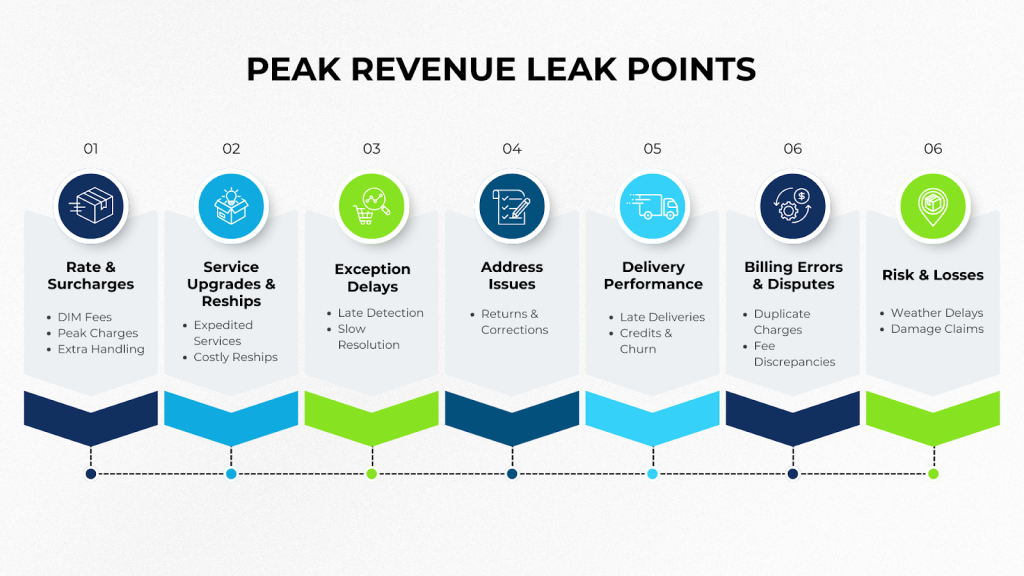
The Hidden Cost Multipliers: Surcharges, Fees, and Dimensional Weight
Peak season fees add up quickly and often appear scattered across invoices, making them easy to miss unless you deliberately isolate them. These hidden multipliers can inflate parcel spend significantly without triggering immediate attention.
Review how much peak season surcharges increased your total cost. Then, examine common extra fees:
- Fuel charges
- Residential delivery fees
- Oversized package fees
- Extended delivery area fees
Dimensional weight deserves particular attention. When carriers charge based on package size rather than actual weight, inefficient packaging directly increases cost. Dimensional weight is often the fastest packaging-driven cost lever. Quantify how often it applied and the delta versus actual-weight pricing. This analysis often reveals immediate savings opportunities through packaging optimization.
Once you know where surcharges concentrated, the response is simple: cut the exposure you control and plan around the exposure you don’t. Packaging is usually the fastest win, since right-sizing cartons lowers dimensional-weight penalties on every future shipment. From there, match carriers and service levels to each lane’s surcharge profile, because the cheapest base rate often isn’t the cheapest all-in cost once accessorials are added. Where surcharges are unavoidable, build them into peak pricing and carrier negotiations instead of absorbing them quietly, and use this peak’s carrier scorecard as leverage on accessorial terms.

Profitability Blind Spots: Find the Orders That Lose Money
Peak season can scale unprofitable patterns that exist year-round but remain hidden at lower volumes. When volume surges, these patterns become significant cost drivers.
Some order profiles reliably lose money at peak volumes, especially far-zone shipments, bulky items, and high-return categories. Far-zone and long-distance shipping patterns often inflate costs beyond what the order margin can absorb. Products with high return rates create double shipping cost exposure since you pay for both outbound and return shipping.
Channel mix changes also matter. Marketplace orders often carry different cost structures than direct-to-consumer orders. If your channel mix shifted during peak, this may have changed your overall cost profile in ways that deserve analysis.
Forced Costs vs. Avoidable Costs: Rate, Capacity, and Service Upgrades
Not all cost increases are created equal. Some come from rate structure and contract terms that apply regardless of decisions you make. Others come from constrained capacity that forces expensive choices in the moment.
Service upgrades are usually a symptom, not the root cause. These upgrades often represent preventable costs if earlier decisions had been different. Examine missed pickups, delayed handoffs, or carrier slowdowns that triggered extra costs downstream.
Where you used backup carriers or last-minute alternatives, calculate what that cost compared to your primary options. This analysis reveals the premium you paid for flexibility and whether building more proactive carrier diversification would reduce that premium next season.
The way to get ahead of this is to compare your options before peak rather than in the moment. Modeling carrier mix, service levels, and capacity commitments against expected volume shows you which combinations hold their cost under pressure, so the expensive last-minute upgrade becomes the exception instead of the default.
When Operations Become Expensive: Bottlenecks That Create Profit Leakage
Delays are not just operational inconveniences. They trigger extra handling, more exceptions, faster shipping upgrades, and customer credits. Every hour of delay in the order-to-ship cycle can translate into direct cost increases.
Analyze your order-to-ship cycle time during peak versus baseline periods. It’s important to identify where repeated handoff delays occurred between order receipt, carrier pickup, and in-transit movement. Look for patterns where technology or process breakdowns created manual workarounds that added time and cost.
Detection speed matters significantly. Issues discovered quickly can often be resolved at a lower cost than issues discovered later. Exception timing is a cost lever: early detection is cheaper to fix than late discovery.
Shipping Policy Profit Leaks: Free Shipping, Flat Rates, and Delivery Promises
Shipping policies can quietly lock in margin loss during peak, especially when costs rise, but pricing and promises remain unchanged. These structural decisions deserve careful review.
Free shipping thresholds often create a margin trap: orders barely over the line can be the least profitable. Orders barely over threshold often cost more to ship than orders well over threshold, yet both receive the same free shipping benefit. This dynamic can erode margin on a significant portion of peak orders.
Flat-rate shipping can become an unintended discount during peak if zones and weights outpace the price you charge. If not, flat-rate shipping may have operated as an unintended discount during the highest-cost period of the year. Review expedited shipping uptake and margin impact by segment. Finally, assess delivery promise creep and where it forced service upgrades or customer credits.
The True Cost of Service Failures: Refunds, Reships, and Lost Customers
Late deliveries create direct revenue loss through customer credits and indirect loss through customer churn. Both deserve quantification in your post-peak analysis.
Track the volume and themes of WISMO contacts during peak. Calculate the total cost of refunds, reships, and delivery-related customer credits. Review customer satisfaction movement during peak and identify what drove changes in either direction.
Proactive communication can reduce escalation costs significantly. Evaluate where automated notifications reduced customer service burden and where communication gaps created unnecessary contacts. This analysis often reveals high-ROI investments in alerting and notification infrastructure.
Billing Accuracy Check: Did the Invoice Match What You Expected?
A meaningful share of margin leakage shows up after the fact through inaccurate charges, corrections, or missed dispute windows. Billing errors are common during peak when carrier systems process higher volumes and exceptions. Use our Post-Peak Shipping Audit Checklist to ensure nothing gets missed.
Review billing accuracy across your carrier invoices. Look for errors, duplicate charges, and unexpected fees. Track dispute volume and time to resolution. Identify categories of recurring issues such as address corrections, extra handling fees, and oversized classifications.
For each recurring issue, evaluate whether earlier detection could have prevented the charge. Continuous audit intelligence surfaces discrepancies in real time rather than waiting for quarterly review. Organizations with strong cost discipline invest in tools that turn their transportation budget from a black box into a monitored system.
Risk Review: Weather, Disruptions, and Loss Events That Spiked Costs
Peak season disruption is predictable in aggregate even when specific events are not. The question is whether you contained the cost impact when disruptions occurred.
When peak disruption hit, did you have options or were you locked into one path? Look at weather-related delays and the reroute decisions they triggered, then quantify loss and damage patterns (claims frequency and resolution speed). Finally, compare whether alternate carriers reduced the disruption impact or whether single-carrier dependency amplified costs.
Organizations with multi-carrier strategies and dynamic routing capabilities typically absorb disruption at lower cost than those locked into single-carrier relationships. This analysis reveals the value of building network flexibility before peak season begins.
Shipping Cost Optimization Changes to Make Before Next Peak Season
Turn your retrospective into decisions with clear owners, timelines, and expected savings. The most impactful cost optimization programs address several areas at once:
- Carrier strategy. Diversify carriers and rebalance your service mix so no single lane depends on one provider, then negotiate from this peak’s performance scorecards rather than list rates. Model the cost and capacity tradeoffs of each option before you commit, so you choose a mix that holds up under next peak’s volume.
- Packaging. Right-size cartons to reduce oversized and dimensional-weight penalties, which lowers cost on every shipment year-round, not just at peak.
- Shipping policy. Revisit free-shipping thresholds, premium pricing, and delivery promises that eroded margin, and reset them before the next surge locks the loss back in.
- Monitoring and alerts. Set alerts on exceptions and cost spikes so you catch problems in-season, when early detection is cheaper than a post-peak correction.
- Continuous auditing. Audit carrier invoices on an ongoing basis to prevent recurring billing leakage, instead of waiting for a quarterly review to surface it.
Each of these investments pays dividends across the entire year, not just during peak.
Peak season does not reward guesswork. It rewards organizations that understand their data, test their assumptions, and build flexibility into their network.
When your systems can model future states and automate decisions that used to depend on manual reaction, peak season transforms from a margin risk into a growth opportunity.