Five or six years ago, blockchain was the technology that every logistics platform claimed to use. Most vendors, when pressed for a specific use case, did not have one. The hype cycle passed, and the platforms that survived were the ones that had been solving real customer problems all along.
Logistics shipping AI is on the same trajectory today. Every platform claims to have AI, and most of those claims fall apart the moment you ask what problem the AI is actually solving and what data it is running on.
The real variable in every AI outcome is the data underneath it. Clean, unified, normalized shipment data produces useful AI output. Fragmented data produces hallucinations dressed up in a confident interface. That is the gap between vendors who have done the data work and vendors who have layered AI on top of the same software that existed two years ago.
What follows is why data quality is the prerequisite for applicable AI in shipping, and how the right data foundation translates into two outcomes that show up on your operations and finance reports: cost control and service performance.
What “Applicable AI” Means in a Logistics Shipping Context
“AI” is one of the most overloaded terms in software right now. In shipping, it gets applied to everything from rules-based automation that has existed for decades to machine learning models genuinely trained on shipment data. When a vendor says their platform uses AI, the term itself tells you very little.
Enveyo uses a more useful term: applicable AI. The idea is straightforward. AI is a tool, not a category of marketing copy. The relevant question for any AI feature is not whether AI is involved, but whether it solves a specific operational problem faster, more accurately, or with less manual effort than the alternative. The goal is not to replace people; it is to compress the time between a question and a defensible answer.
Applicable AI in shipping depends entirely on the data it can access. A model running on clean, unified shipment data produces a more reliable output than the same model running on partial, fragmented inputs. That is the structural reality of how applied AI works, and the reason data quality is not a side issue. It is the central issue.
Why Data Quality Determines What Logistics Shipping AI Can Actually Do
If the data is not clean, the AI output will not be either. Garbage in, garbage out is not a tired phrase here; it is the operating principle.
AI hallucinations in shipping happen for a specific reason. The model is asked to recognize patterns across data that is internally inconsistent: tracking events stored under different status codes by different carriers, charges named differently across invoice formats, and service levels classified differently across systems. When the inputs disagree on what the same thing is called, the model is left to guess, and a confident-looking wrong answer results.
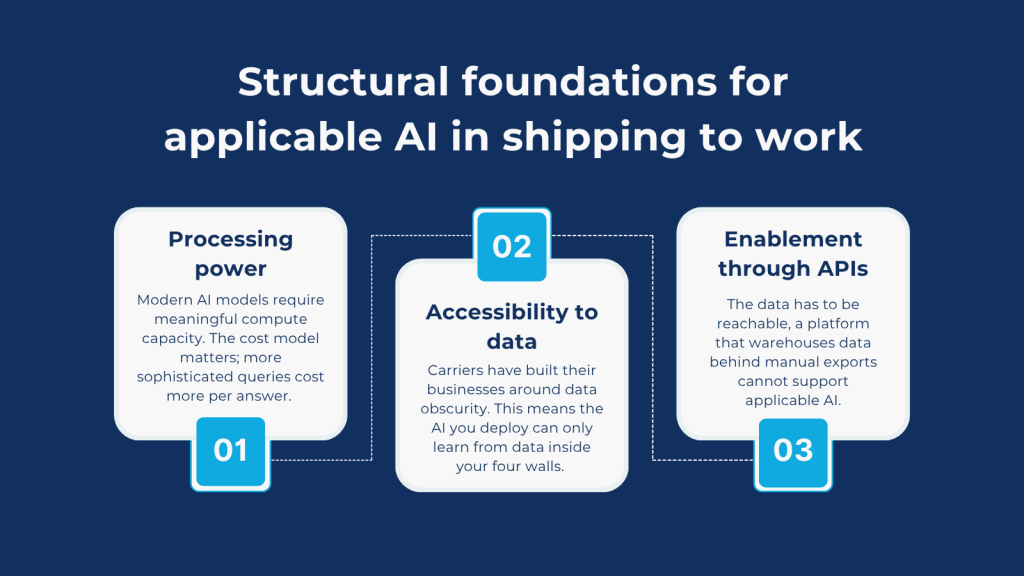
Three structural foundations have to be in place for applicable AI in shipping to work:
- Processing power. Modern AI models require meaningful compute capacity. That is largely solved in the cloud era, but the cost model matters; more sophisticated queries cost more per answer.
- Accessibility to data. Carriers have built their businesses around data obscurity, and most carrier agreements prevent customers from sharing pricing or shipment data externally. There is no language model that knows what every shipper pays, which means the AI you deploy can only learn from data inside your own four walls.
- Enablement through APIs. The data has to be reachable programmatically. A platform that warehouses data behind manual export workflows cannot support applicable AI.
Two implications follow. First, the data advantage in logistics shipping AI is built internally. Unified, normalized data across your own operation is the closest thing to a real moat. Second, even strong AI models need quality assurance on their outputs. The mark of applicable AI is that it tells you how confident it is in its own answer and treats human review as part of the workflow.
Why Most Shipping Operations Are Not Set Up for Logistics Shipping AI Yet
Many logistics AI platforms on the market today were built by people who came out of the carrier world. That background shapes the architecture. The natural starting point is the data source the founders know best, with additional sources added as the customer base demands them. The result is a system that grows outward from a single source.
Enveyo took a different path. The platform was built from the start as an open data platform, designed to ingest shipping, finance, OMS, WMS, and carrier data without privileging any one source. The distinction matters when evaluating what AI running on the platform can actually do.
The shipper or 3PL reality is messier still. Data is fragmented across OMS, WMS, TMS, multiple carrier portals, finance systems, and the systems of acquired entities running on different stacks. The same shipment event might be a “delivery exception” in one system and a coded value in another.
Field-naming inconsistency is everywhere once you start looking. Surcharges are a painful example. What one carrier files as a residential delivery surcharge, another files as a delivery area surcharge, and a third splits across “delivery area” and “extended delivery area.” Service-level naming is no better; Ground, SurePost, SmartPost, and Home Delivery are different commercial names for similar fulfillment tiers. Applicable AI cannot generate a reliable spend analysis across carriers until the naming differences are reconciled first.
This is where AI is actually doing useful work in shipping today, and has been for years: data mapping. AI parses files it has never seen before, identifies the elements that matter (account number, date, weight, cost fields, service-level indicators), maps them to standard fields, flags its confidence in each match, and learns from human correction over time. It is one of the most mature applications of applicable AI in shipping, and the foundation on which everything else sits.
The Wrong Integration Question, and the Right One
When evaluating a logistics shipping AI platform, most buyers default to the same opening question: “What integrations do you have?” The answer is always a list, and the list always looks reassuring on paper.
The list tells you almost nothing about whether the platform will hold up when the carrier mix changes, contracts renew with new file formats, an acquired entity brings a different system into the operation, or a new carrier needs to be added that no one had considered at evaluation time.
The better question is structural. Ask the vendor, “What is your methodology for integrations?” Or, “What is your architecture for handling data we have not connected before?” A list is a snapshot. A methodology is a position.
Applicable AI compounds in value with the breadth and consistency of the data it sees. A platform built to absorb new sources cleanly gives the AI on top of it a wider, more consistent field of patterns to learn from. A platform that hard-codes each integration gives the AI a brittle, partial view that degrades with every contract renewal.
In an evaluation, push the vendor to walk through a specific scenario. What happens when a carrier changes file formats mid-contract? What happens when you add a new OMS? The answer tells you whether the architecture is built for applicable AI or merely optimized for today’s integration list.
How Smarter Data Drives Shipping Cost Optimization
Logistics shipping AI can only optimize spend it can actually see. Unified, normalized shipment data is what makes the spend visible at the level applicable AI needs.
Four common cost levers unlock once the data foundation is in place:
- Parcel audit accuracy. AI flags billing errors and recovery opportunities reliably only when invoiced charges are joined to the shipment context they belong to. Invoices in isolation tell you what you were charged; invoices joined to shipment data tell you what you should have been charged.
- Carrier selection. AI can compare rates, service, and historical performance across carriers only when the comparisons are apples-to-apples. That requires normalized service-level definitions, normalized surcharge taxonomies, and consistent performance data across the carrier mix.
- Surcharge identification. AI surfaces patterns in residential, dimensional, and accessorial charges only when the surcharge taxonomy is normalized. Without normalization, the same surcharge looks like three different surcharges, and the patterns stay hidden.
- Packaging optimization. AI evaluates dimensional weight and box-fit decisions only when SKU and shipment data are joined at a level that supports cartonization logic.
Each of these levers exists in your data already. What unifies them is whether your infrastructure makes the patterns visible to AI in the first place.
The shift the data foundation enables is from reactive to proactive. Reactive cost control finds the issue after the invoice arrives. Proactive cost control catches the decision before the shipment ships. Scenario modeling sits at the proactive end, where applicable AI pressure-tests a cost decision against historical patterns before money is committed. This is how shipping cost optimization shifts from a quarterly contract negotiation to a continuous, shipment-by-shipment question.
For 3PLs, the picture gets exponentially more complex with each client added. Unified data is the only way to surface where margin is leaking across the book.
How Smarter Data Drives Service and Delivery Performance
The cost case for applicable AI is easy to see on the P&L. The service performance case is just as compelling and easier to underweight. Every meaningful service performance metric is downstream of clean shipment data.
There is a structural reality worth naming. You’re not in the reporting platform every day, and that isn’t a failure of attention. It’s the role. Your time goes to contract decisions, customer relationships, peak season prep, and the operational fires that need a leader’s judgment. The trade-off is that some issues surface after they’ve already become escalations, when they could have been caught while they were still patterns in the data.
Applicable AI on a unified data foundation closes that gap by changing what reaches leadership. Instead of requiring senior leaders to find the patterns, the AI identifies them and surfaces what needs attention in the channels leaders actually read: email digests, scheduled summaries, alerts that trigger on operational thresholds. The data analytics role in improving delivery performance shifts from “build the report someone asked for” to “surface the trends nobody knew to ask about.”
The delivery performance KPIs that matter most are well understood; the harder question is whether the data foundation supports them at the granularity teams need:
- On-time delivery rate by carrier, zone, and service level
- Exception rate and exception type patterns over time
- Transit time variance against committed service-level agreements
- Carrier reliability scoring under volume pressure (peak season, surge events)
- Last-mile cost-to-serve relative to delivery commitments
Each of these depends on data that lives across multiple systems. When those sources are not unified at the shipment level, applicable AI is left guessing at the joins, and the KPIs that come out the other end are estimates dressed up as measurements.
For 3PLs, this lands with extra force. 3PL delivery performance is the metric every client evaluates the relationship on. A unified data foundation is what allows performance reporting to scale across a growing client book without proportional growth in analyst headcount. The companion piece on peak season KPIs covers the specific metrics in greater depth.
Where Logistics Shipping AI Still Falls Short
Applicable AI is real, and it is doing useful work in shipping today. It is also not a finished product. Applicable AI requires applicable expectations.
Four limits worth naming:
Data accessibility outside your own four walls. Carriers protect their pricing and shipment data with contractual obscurity. The AI you deploy learns from your operation’s data, which means the breadth and quality of your internal data foundation is the upper bound on what the AI can do.
The prompting gap. Customers do not always know what to ask. AI can build a report on cost-per-unit shipments originating in California, broken out by carrier and service level, but knowing what conclusion to draw still requires human judgment.
Cost considerations. More sophisticated AI models cost more per query. Operations have to think strategically about which questions are worth paying advanced AI to answer.
Hallucination risk on weak data foundations. Even strong models produce confident-looking wrong answers when the inputs are fragmented or stale. The remedy is the same as throughout this article: clean, unified data plus human review on AI outputs. There is no shortcut around either step.
The takeaway is simple. When evaluating any platform that claims AI for shipping cost or service performance, ask about the data layer first. Everything else flows from there.
Building Toward Logistics Shipping AI That Actually Improves Cost and Performance
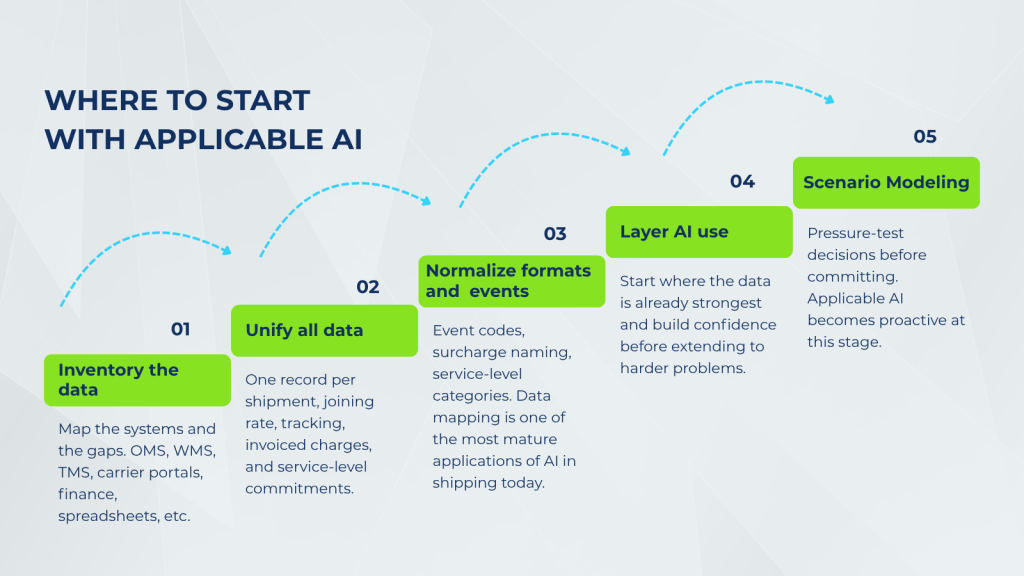
For shippers and 3PLs evaluating where to start with applicable AI, the work breaks into five practical steps:
- Inventory where shipment data lives today. OMS, WMS, TMS, carrier portals, finance, spreadsheets. Map the systems and the gaps.
- Unify shipment-level data across carriers and systems. One record per shipment, joining rate, tracking, invoiced charges, and service-level commitments.
- Normalize the formats and event taxonomies. Tracking event codes, surcharge naming, service-level categories. Applicable AI is well-suited to this layer; data mapping is one of the most mature applications of AI in shipping today.
- Layer AI use cases on top of the clean foundation. Start where the data is already strongest, often parcel audit or carrier selection. Build confidence before extending to harder problems.
- Use scenario modeling to pressure-test decisions before committing. Applicable AI moves from reactive to proactive at this stage.
When evaluating logistics shipping AI vendors, three questions matter more than the feature list:
- What is your data architecture, and can it absorb sources you haven’t connected before?
- Does the AI accelerate the answer in a way that would be impossible or impractical to get another way?
- How does human review fit into the AI’s workflow?
You don’t need to solve all of this at once. Start with the inventory step. Map where your shipment data lives today, where it doesn’t connect, and where the gaps are. That single exercise will tell you more about your AI-readiness than any vendor pitch will. From there, the path to applicable AI is a sequence, not a leap.
When you’re ready to see applicable AI working on real shipping data, scenario modeling for cost and service decisions is where the data foundation argument becomes a working evaluation environment. Predict every outcome. Act with confidence.