Machine learning is the engine under most of what gets marketed as “shipping AI” today. Strip away the branding, and it is something more specific and less mysterious: pattern recognition trained on historical data. It studies what has already happened across your shipments and uses those patterns to predict what is likely to happen next. That is genuinely useful, and it’s not magic. Machine learning in the shipping industry only works when the underlying data is good enough for the patterns to be real.
That distinction matters because the useful question is not whether a platform “uses machine learning.” Almost all of them now do, or say they do. The useful question is narrower: what can the model reliably predict, and where does prediction tip over into overconfidence on messy data? This article walks through how machine learning actually works inside shipping and parcel operations, the predictive use cases where it earns its keep, and the line between a prediction worth acting on and noise dressed up as insight. The frame throughout is applicable machine learning: not technology for its own sake, but models pointed at specific problems that change a specific decision.
Key Takeaways
- Machine learning in shipping is pattern recognition trained on historical shipment data. It is not magic, nor is it generative AI.
- Its predictions are only as reliable as the data underneath. Fragmented or inconsistent data produces confident but unreliable output.
- It earns its keep in specific predictive use cases: delivery and transit time prediction, exception and delay risk, demand and volume forecasting, and route and network optimization.
- It cannot predict truly novel events, see data that’s inaccessible to your operation’s data, or replace human judgment about what to do with a prediction.
- The simplest way to evaluate it: does the prediction change a decision you would otherwise make?
What Machine Learning Actually Is in a Shipping Context
Machine learning is a branch of applied AI in which a model learns patterns from historical data and uses them to predict or classify new data. It is not a set of rules hand-coded by engineers, and it is not generative AI, the branch that writes text or images. In a shipping context, the data it learns from is shipment-level: origins, destinations, carriers, service levels, weights, dimensions, transit outcomes, and charges.
This is different from the broad “AI for supply chain” language you see everywhere, and narrower than AI in shipping as a whole. Machine learning is the specific mechanism that powers prediction. When a platform promises to forecast demand, flag a delay before it happens, or pick the best carrier for a shipment, machine learning is usually what is doing the work behind the label.
This is also why the “not magic” point matters in practice. A model surfaces patterns that already exist in your data, and it cannot invent a signal that is not there. So the same machine learning in logistics can produce sharp results for one operation and unreliable results for another, based entirely on the data each one feeds it. If you want to see where that plays out across real carrier, shipper, and 3PL operations, we cover it here, but the underlying question is the same. Where is the AI actually doing work, and is the work worth doing?
How Machine Learning Works Under the Hood, Without the PhD
You do not need the math to evaluate machine learning well. You need to understand how it works in plain terms.
A model studies a large set of historical shipments, learns the relationships between inputs and outcomes, then scores or predicts new shipments as they arrive. Feed it enough records where you know both the inputs (origin, destination, carrier, service level, weight, dimensions, lane history, time of year) and the outcome (how long delivery actually took, whether an exception occurred, what it actually cost), and it learns which combinations tend to lead to which results. When a new shipment appears, the model compares it to everything it has seen and produces its best estimate.
Two things follow, and both are practical rather than technical. First, historical depth matters. A model can only learn from what it has seen, so a new operation, or one that recently switched systems, can hit a cold-start problem: not enough history yet for the predictions to hold up. That is not a flaw in the model; it is a fact about learning from data. Give it time and clean history, and the predictions sharpen.
Second, more data and cleaner data improve the model, but neither guarantees a correct answer in a genuinely new situation. A pattern the model has never encountered is one it cannot confidently predict. Naming that boundary up front is not a weakness; it is how you use the technology responsibly.
It is also worth being clear about where the advantage actually comes from. In shipping, the useful data mostly lives inside your own operation. Carriers guard their pricing and performance data closely, so no model has a clean, market-wide view of what every shipper everywhere is paying or experiencing. The edge does not come from some giant external dataset. It comes from unifying and cleaning your own shipment data so a model can finally see it clearly.
Predictive Use Cases Where Machine Learning Earns Its Keep
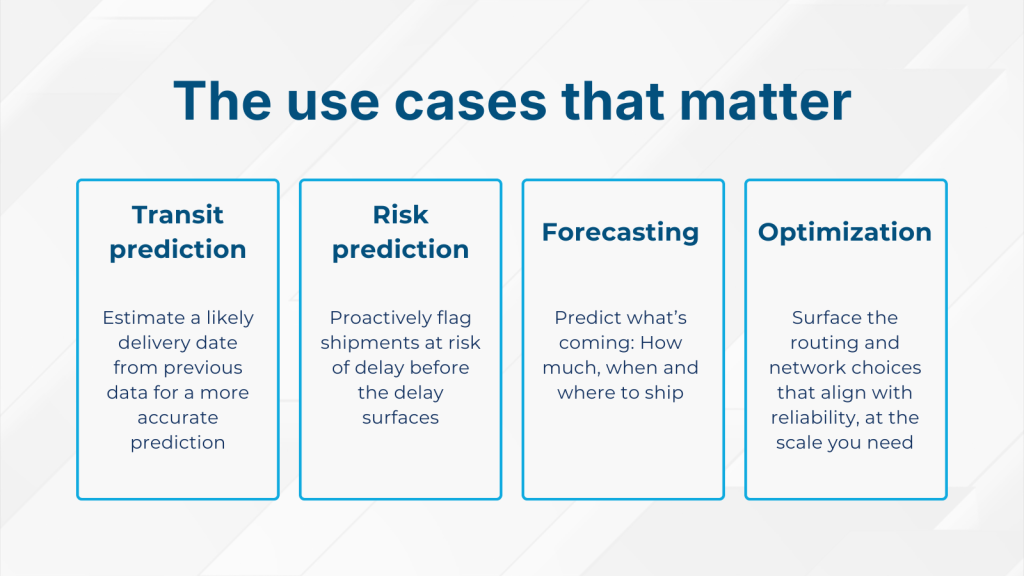
The use cases that matter are those in which a prediction changes a decision. These are the machine learning use cases in logistics where the model does real work, not where it decorates a dashboard.
Delivery Time and Transit Prediction
Predicting shipping time with machine learning means estimating a likely delivery date from the inputs that actually drive it: origin, destination, carrier, service level, and lane history. Instead of quoting a carrier’s static, conservative service window, the model looks at how shipments on that lane have really performed and predicts what is likely this time. Operationally, that supports two things: proactive customer communication, telling people when their order will actually arrive, and faster exception triage, spotting the shipments that will not hit the promised window.
Exception and Delay Risk Prediction
A step further, the model can flag shipments at risk of delay before the delay surfaces. The value here is proactive surfacing: instead of waiting for a shipment to become a customer escalation, the system brings the at-risk shipment to the right person while there is still time to act. This only works when real-time events and historical patterns live in the same place, so the model can weigh what is happening now against what has usually led to problems.
Demand and Volume Forecasting
Machine learning supply chain forecasting uses historical shipment volumes to predict what is coming: how much you are likely to ship, when, and where. That supports carrier and network capacity planning, peak-season preparation, and rate-negotiation prep. That same limit applies here. A forecast is only as reliable as the history behind it and the conditions staying steady, so a model trained on last year’s patterns will not, on its own, see a major shift coming.
Route and Network Optimization
Logistics route optimization using machine learning evaluates lane, carrier, and mode combinations against cost and service tradeoffs, then recommends better routing than a static rules engine would. As the number of carriers, lanes, and zones grows, the combinations quickly exceed what a person can weigh by hand. This is where machine learning supply chain optimization earns its place, surfacing the routing and network choices that balance cost against service reliably and at scale, the same kind of pattern-based forecasting that drives predictive analytics in modern logistics.
Why Machine Learning Lives or Dies on Data Quality
Everything above depends on one thing: the model can only learn from the data it is given. Fragmented, inconsistent, or incomplete inputs produce fragmented, inconsistent, unreliable predictions. That is the real reason two operations running the same tool get different results.
Machine learning has one failure that is worth understanding before you rely on it. A model returns a confident-looking prediction whether or not the data underneath it is sound. It does not hesitate, and the team often finds out the prediction was wrong only after acting on it. That is why a strong data foundation is not a side project; it is the thing that makes the predictions trustworthy in the first place. Getting that foundation right, unifying and normalizing shipment data across carriers and systems, is a big enough topic that we gave it its own guide, and it is worth reading next if reliable predictions are the goal.
What Machine Learning Cannot Do in Shipping, Yet
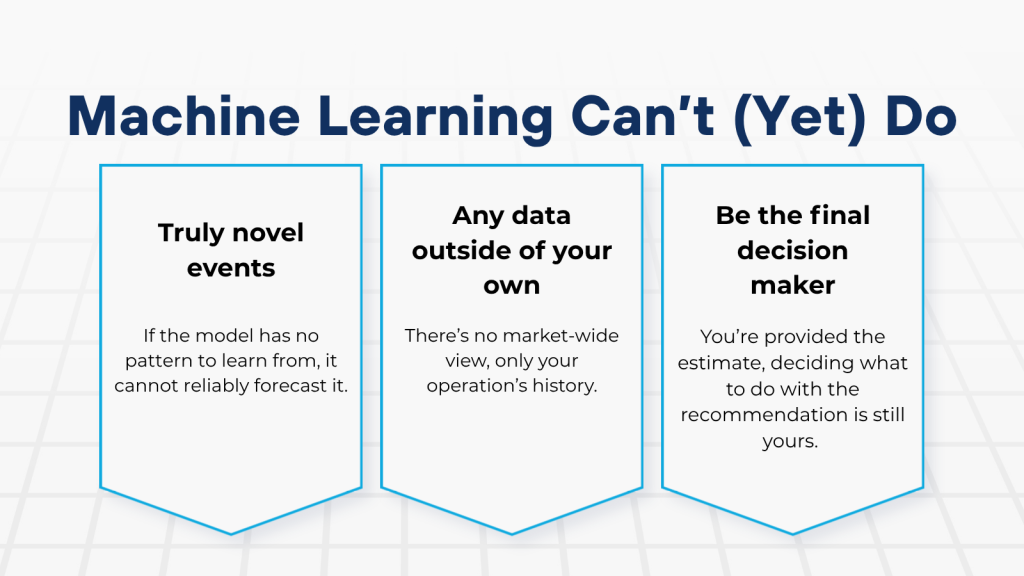
Being clear about the limits is part of using the technology well, and it is where a lot of shipping software stays quiet.
It cannot predict truly novel events. If something has never happened before in your data, the model has no pattern to learn from, so it cannot reliably forecast it.
It cannot see outside your own data. Because carriers protect their information, there is no market-wide view for a model to learn from. Your model learns from your operation’s history, which is both a real limit and, once your data is unified, a real advantage.
It cannot replace human judgment. The model produces an estimate; deciding what to do with it is still yours. A prediction that shipments from one region cost more per unit is a fact to act on, not a decision the model makes for you.
And overconfidence on weak data remains the most common failure mode of all. A polished output on top of broken inputs is still a broken output.
How to Evaluate Machine Learning in a Shipping Platform
If you are assessing a platform that claims machine learning, a few questions cut through the marketing fast:
- What is the model trained on, and how much history does it need? This tells you whether it will work on your data or just the vendor’s demo data.
- How does it handle a cold start? A good answer means the platform is honest about what happens before it has enough of your history to learn from.
- How is prediction accuracy measured over time? You want a platform that tracks whether its predictions actually hold up, not one that claims accuracy once and moves on.
- Does it show a confidence level with each prediction? A single confident number hides uncertainty. A confidence level lets you weigh how much to trust it.
- Does the prediction change a decision you would otherwise make? This is the pragmatic test. If the answer is no, it is a metric, not a tool, however sophisticated the model behind it.
The pattern in strong answers is consistent. The platform can tell you exactly what data it needs from you, how it unifies and normalizes that data, and what the model does when it is uncertain. That is the logic behind Enveyo Modeling: test cost and service decisions against your own data before you commit to them. Predict every outcome. Act with confidence.
Frequently Asked Questions
Is machine learning the same as AI in shipping? No. Machine learning is a subset of applied AI focused on prediction and pattern recognition. It differs from generative AI, which produces content such as text and images. When shipping software promises forecasting or delay prediction, machine learning is usually the mechanism doing the work.
What does machine learning need to make reliable predictions? Enough historical shipment data, consistent inputs, and a clearly defined prediction target. Thin or inconsistent data limits what any model can reliably predict, no matter how advanced it is.
Can machine learning predict delivery and transit times? Yes. It estimates a likely delivery date based on origin, destination, carrier, service level, and lane history, supporting both proactive customer communication and faster exception triage.
Why do machine learning predictions sometimes go wrong? Usually, because the underlying data is fragmented or inconsistent. The model still returns a confident-looking answer, so the error is often caught only after someone acts on it.
What can machine learning not do in shipping? It cannot reliably predict truly novel events, see outside your own operation’s data, or replace human judgment on what to do with a prediction.
How do I evaluate machine learning in a shipping platform? Ask what the model trains on, how much history it needs, how it handles a cold start, whether it shows a confidence level, and whether the prediction actually changes a decision you would make.