“AI shipping management” sounds like a single product you can buy, switch on, and check off the list. It is not. It is a shift in how a shipping operation runs day to day, where automation absorbs repetitive work and AI surfaces the patterns that used to require an analyst to hunt for. The label is not the point. What matters is what actually gets automated, what gets surfaced, and what gets faster.
This article defines AI shipping management as a category, walks through the automation and insight layers in operational terms, and gives shippers and 3PLs a practical way to evaluate whether the move is worth making. The frame throughout is what Enveyo calls applicable AI: tools built around real operational problems, not AI for its own sake.
Key Takeaways
- AI shipping management is not one product; it is automation and insight layered across the shipping stack on a unified data foundation.
- Automation handles the repetitive work: carrier selection, rate shopping, audit, routing, and document and compliance handling.
- Insight surfaces what matters, bringing patterns to decision-makers instead of waiting for someone to log in and find them.
- The value depends on the data underneath; fragmented data limits what automation and insight can deliver.
- Shippers gain proactive cost and service control; 3PLs scale client reporting and exception management without adding headcount in proportion.
- Evaluate it by the operational problem it solves, not the AI label.
What AI Shipping Management Actually Means
AI shipping management is the integration of AI-driven automation and insight across the shipping operations stack. It is not a single feature or a bolt-on module. It is the connective layer that ties rate shopping, carrier selection, parcel audit, tracking, reporting, and alerting together and runs them on one unified data foundation.
That distinction separates it from the point tools most operations already run. A standalone rate-shopping tool solves the rate-shopping problem. A standalone audit tool solves audit. AI shipping management is what happens when those functions share the same clean, normalized shipment data and start informing each other, so a carrier decision reflects audit history and a service-level choice reflects real lane performance.
The useful way to think about it is not “does this use AI” but “what problem is the AI pointed at.” Automation in shipping earns its place when it removes manual steps that add cost and delay. Insight earns its place when it puts the right pattern in front of the right person at the right moment. Everything that follows is a version of those two ideas. You will also see this territory described as AI shipping software, which is the same idea named a little differently.
The Automation Layer: What Gets Handled for You
Start with the benefits of logistics automation, because they are the easiest to feel: fewer manual touches, faster cycle times, and fewer errors slipping through to the invoice or the customer. Automation is the layer that quietly removes work your team should not have to do by hand.
Carrier selection and rate shopping run automatically on every shipment, evaluated against your own cost and service rules rather than a static default. Parcel audit runs the same way: invoices are parsed, billing errors and refund opportunities are flagged, and recovery surfaces without anyone reviewing statements line by line. Routing rules, label generation, and document handling move from manual steps to automated ones, so the work that used to eat an afternoon happens in the background.
Compliance documentation belongs here too. Automated checks and document generation help a shipping operation keep pace with regulatory requirements without a person tracking every rule change by hand.
Underneath all of this sits a less visible but more important capability: the system has to read and normalize the data in the first place. Shipping data arrives in dozens of formats, and one carrier’s “tracking number” is another’s “tracking ID.” Automated parsing and mapping handle that variation, populating the right fields regardless of carrier or file type, so the automation above it has clean inputs to work from. For a broader tour of the tool set that automates parcel operations, our guide to multi-carrier parcel shipping software covers the ground in more depth.
The Insight Layer: What Gets Surfaced
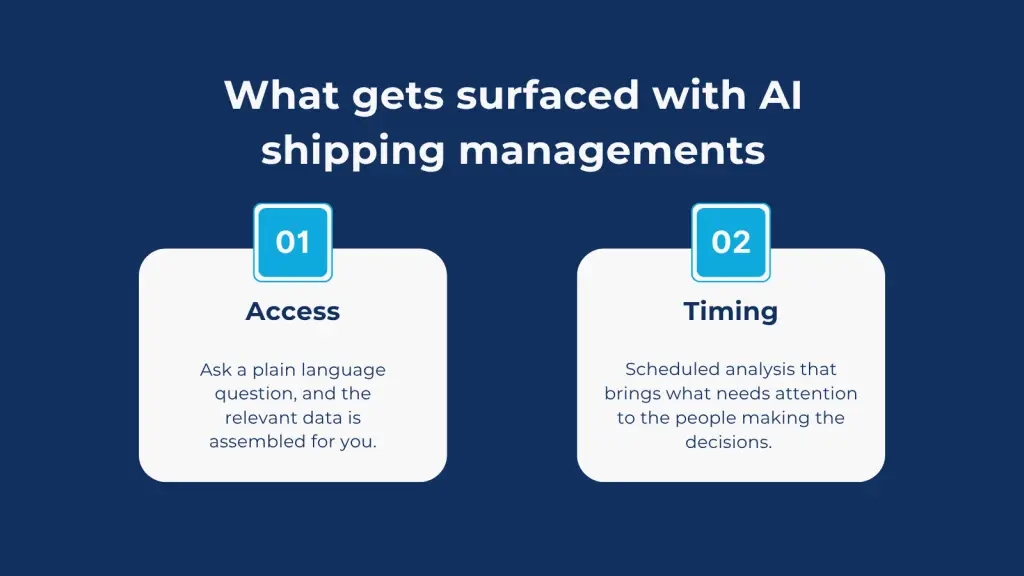
Automation does the work. Insight tells you what matters. This is where AI shipping management moves from handling tasks to shaping decisions.
The first shift is access. You no longer have to know how to build a report to get an answer from your data. Ask a plain-language question about your shipments, and the system assembles the relevant dataset for you, which lowers the barrier for the people who need answers but do not live in the platform. Natural-language reporting like this is quickly becoming standard across the industry, so it is worth being clear about where the value actually sits: not in the question box itself, but in the clean, unified data underneath it that makes the answer trustworthy.
The second shift is timing. Instead of waiting for someone to log in and go looking, the system runs scheduled analysis and brings what needs attention to the people who make decisions. Most senior leaders, the VPs of supply chain and operations who own these outcomes, are not in a reporting platform every day. So the insight reaches them where they actually work: a digest, a scheduled summary, an alert that trips when something crosses a threshold. A simple read of on track, needs attention, or high risk is often enough to tell a leader where to spend their next hour.
What this changes operationally is straightforward. Issues get caught while they are still patterns in the data, not after they have hardened into customer escalations. The mechanics of how the model actually makes future predictions are examined in our machine learning in the shipping industry guide.
Why the Data Foundation Decides the Outcome
None of this works better than the data underneath it. Automation and insight both inherit the quality of the shipment data they run on, and fragmented, inconsistently named data caps how far either one can go.
That is why the sharpest question to ask a vendor is not “what do you integrate with” but “what is your methodology for integrations.” A list of connectors is a snapshot; a methodology tells you whether the foundation holds up when your carrier mix changes or a new system comes online. Explore the importance of the data foundation and how it drives cost control and service performance.
What Changes for Shippers vs. 3PLs
The layers are the same for everyone, but the payoff lands differently depending on how you operate.
Shippers
For shippers, AI shipping management shows up as cost control and service performance across the carrier mix. Audit and optimization run automatically, and reporting surfaces itself rather than waiting to be chased. The real change is one of posture: the operation moves from reactive review, catching problems after the invoice arrives, to proactive management, acting on them while they are still forming.
3PLs
For 3PLs, the challenge is complexity: many clients, many networks, many carrier relationships, each with its own reporting expectations. This is where AI shipping management lands hardest. Client reporting and exception management scale across a growing book of business without headcount growing in lockstep, which is the structural economic argument for adopting it. For a fuller view of how carriers, shippers, and 3PLs each put these tools to work, our survey of shipping AI use cases breaks it down by audience.
The AI Tools Behind AI Shipping Management
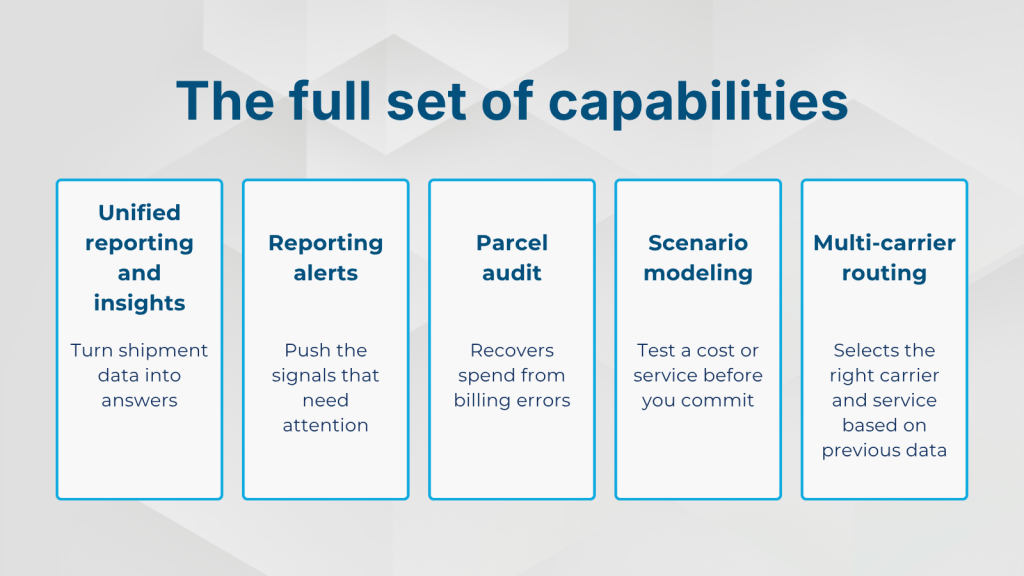
AI shipping management is not one tool; it is a set of capabilities working off shared data. It helps to see the functional categories, then follow the product links for the specifics.
- Unified reporting and insights turn normalized shipment data into answers.
- Reporting alerts and scheduled AI-analysis push the signals that need attention to the people who need them.
- Parcel audit recovers spend that would otherwise leak away in billing errors.
- Scenario modeling lets you test a cost or service decision against your own data before you commit to it.
- Multi-carrier routing selects the right carrier and service per shipment once the data layer is normalized across the full carrier mix.
Here is the part worth being honest about. Nearly every platform in this space now claims AI tools, and asking questions of your data in plain language is fast becoming table stakes. So when you compare the best AI tools for shipping logistics, “we have AI” is not what separates one from another. What separates them is whether the tools run on a unified, open data foundation and return explainable output you can trust, with a person kept in the loop, rather than a chat layer sitting on top of a single-source database. That is the standard worth holding any of these tools to, including ours. You can see how the pieces fit together on the platform overview.
How to Evaluate AI Shipping Management for Your Operation
If you are weighing a move, start from the operational problem you are trying to solve, not the AI label on the box. From there, a few structural questions cut through the pitch faster than any feature list.
Ask about the data foundation and the integration methodology before you ask about features, because that is what tells you whether the automation and insight will hold up as your operation changes. Ask what is actually automated versus what still needs a person in the loop, and how the system reports its own confidence when it is unsure, since a tool that hides its uncertainty is harder to trust than one that shows it. And ask the practical version of the same question: when your carrier mix or file formats change six months from now, what happens? Then start where your data is already cleanest and extend from there, rather than trying to switch everything on at once.
The clearest way to answer these questions is to see the platform work on real shipping data. Walk through it in a demo, or explore the product pages for the capability closest to your most pressing problem, and judge it by the only test that matters: does it change a decision you would otherwise make by hand?
Frequently Asked Questions
What is AI shipping management?
AI shipping management is the integration of AI-driven automation and insight across the shipping operations stack, running on a unified data foundation. It is not a single product but a connective layer that ties rate shopping, carrier selection, audit, tracking, reporting, and alerting together so they inform each other.
What are the benefits of logistics automation?
Logistics automation reduces manual touches, speeds up cycle times, and cuts errors before they reach the invoice or the customer. In practice that means carrier selection, rate shopping, parcel audit, routing, and document handling run automatically, and reporting surfaces itself rather than requiring an analyst to build it by hand.
How does automation in shipping actually work?
Rules and models run on each shipment against your cost and service criteria, and the system parses and checks documents automatically. Underneath, automated data mapping normalizes shipment data from different carriers and formats, so the automation above it works from clean, consistent inputs rather than guesswork.
What should I look for in AI tools for shipping logistics?
Start from the problem you are solving, then look past the AI label. Ask about the data foundation and integration methodology, whether the output is explainable and confidence-scored, and what is automated versus kept in human hands. Those answers matter more than the length of any feature list.
Can AI help with shipping regulatory compliance?
Yes. AI tools support regulatory compliance in shipping through automated documentation checks and document generation, helping an operation keep pace with requirements without having to track every rule change manually. As with everything else, the reliability depends on the quality of the underlying data.
Does AI shipping management replace analysts or staff?
No. The goal is to help people spend less time finding problems and more time solving them. Automation removes repetitive work and surfaces what needs attention, freeing your team and analysts for higher-value decisions that still require human judgment.