Every logistics platform now claims to have AI. Most of the time, that claim is marketing varnish layered over the same software that existed two years ago. For shippers and 3PLs managing parcel and logistics operations, the real question is not whether a vendor has AI in their pitch deck. It is whether shipping AI is actually doing useful work, where, and on what data.
This article surveys the practical, in-production AI use cases in shipping today. It looks at how the technology is applied across different functions, including audit, carrier selection, parcel optimization, and forecasting, and how the three core audiences in the industry, shippers, 3PLs, and carriers, are putting it to work. The frame for everything that follows is what Enveyo calls applicable AI: tools built around real operational problems, designed to augment people rather than replace them. No speculation. No vague claims about transformation. Just where AI is earning its keep in shipping right now.
What Shipping AI Actually Means
Shipping AI is applied artificial intelligence used in shipping and parcel logistics operations to automate data work, surface patterns, and support carrier and service-level decisions. The label gets stretched in vendor marketing, so it helps to be precise about the working scope.
“AI” is one of the most overloaded terms in software right now, and shipping is no exception. The label gets applied to everything from rules-based automation that has been around for decades to genuinely new machine learning models trained on shipment data. When a vendor says their platform “uses AI,” it could mean almost anything.
For the purposes of this article, shipping AI refers to applied artificial intelligence in shipping operations. That includes:
- Machine learning models that recognize patterns in shipment history
- Intelligent data parsing that handles different carrier formats
- Predictive scoring for delivery and cost outcomes
- Decision-support tools that recommend carriers or service levels based on shipment-level inputs
It does not include theoretical AI, generative AI for content production, or vague “AI strategy” frameworks.
The applicable AI lens is the throughline here. The point of building these tools is not to demonstrate that a platform has AI capabilities. It is to solve specific operational problems faster and with less manual effort than a human could on their own. That distinction matters because it determines what to evaluate when vendors pitch you: not whether AI is involved, but whether the underlying problem is real, the solution is grounded, and the data foundation supports the output.
You will see parallel terms across the market: shipping intelligence, artificial intelligence shipping, AI-driven logistics. All of these overlap with the territory described above. The terminology varies, but the underlying question is the same. Where is the AI actually doing work, and is the work worth doing?
How AI Shows Up in Logistics Software Today
Most AI in logistics software today is built to solve one of a few persistent operational problems. Setting aside feature-by-feature breakdowns, the work falls into three problem categories.
Bringing fragmented shipping data together. Shipping data lives across many systems, including carrier portals, OMS, WMS, TMS, and finance tools, and rarely arrives in a consistent format. AI logistics software accelerates the ingestion and mapping work that used to require days of analyst time, while keeping the human still in the loop for validation. The result is less time spent wrangling data and more time spent using it.
Making shipping data accessible to non-analysts. The skill gap between “I have the data” and “I have an answer” is real in most logistics operations. AI lowers the barrier by understanding plain-language questions, generating relevant datasets, and surfacing patterns that would take hours to find manually. Operations leaders and account managers can ask questions of the data directly rather than waiting in the queue behind analyst workloads.
Surfacing what needs attention before it becomes a problem. Logistics leaders are managing many priorities at once. They need a way to stay informed without checking every dashboard. AI fills that gap by running scheduled analyses, flagging anomalies, and pushing the resulting insight where leaders actually read it: email digests, alerts, and scheduled reports.
The common thread across these categories is that AI is doing the work no team has the bandwidth to do consistently. That is what applicable AI looks like in shipping operations: not a flashier dashboard or a new feature to learn, but a real reduction in the operational load on your team.
Practical Use Cases by Function
Categorizing AI by problem gives a sense of the landscape, but the question most shipping teams actually want answered is what this looks like applied to the work they do every day. Three of the most common AI use cases in logistics today, broken down by function.
Parcel AI for Audit, Cartonization, and Optimization
Parcel AI is one of the most mature application areas in shipping today, largely because parcel data is high-volume, standardized enough to model, and tied to direct financial outcomes. Three common applications:
- Parcel audit: automated detection of billing errors and recovery opportunities
- Cartonization: AI-recommended packing configurations that reduce dimensional weight charges
- Parcel optimization: shipment-level recommendations on carrier, service level, and packaging
Parcel audit is the clearest example. AI parses carrier invoices line by line, identifies billing errors such as late delivery refunds owed, duplicate charges, or incorrect dimensional weight calculations, and flags recovery opportunities. The recovery itself still requires action, but the discovery is automated.
Cartonization is another. AI recommends the optimal box size and packing configuration for each shipment based on item dimensions, carrier dimensional weight rules, and shipping zone. The result is reduced dimensional weight charges and fewer overpacked parcels.
Parcel optimization is broader. AI evaluates each shipment against the available carrier, service level, and packaging options, and recommends the combination that best fits your cost and service targets for that specific order. The optimization happens at the shipment level rather than as a quarterly contract negotiation, which is where the value compounds over time.
AI-Powered Carrier Selection and Rate Shopping
Carrier selection and rate shopping are where applied AI is most mature in shipping today, and for good reason: the problem is well-defined, the inputs are quantifiable, and the outcome is measurable per shipment. Two related applications:
- Rate shopping: real-time evaluation of rate quotes across multiple carriers per shipment
- Carrier selection: AI-driven recommendations factoring rate, service level, performance, and contract terms
Rate shopping is the simpler case. AI evaluates real-time rate quotes across multiple carriers for each shipment and identifies the lowest-cost option that meets the service-level requirement. The attribution is direct, which is why this is often the first AI use case shippers adopt. Solutions like automated carrier rate shopping operate along these lines.
Carrier selection is more nuanced. AI factors not just the rate, but service-level requirements, carrier performance history by lane and service type, customer commitments, and contract minimums. The recommendation balances cost against the broader operational picture rather than optimizing for price alone.Where it breaks down is when the underlying carrier data is fragmented or contracts are unstandardized. AI cannot pick the best carrier across nine carriers if it only has clean data for three of them. That gap is one of the things Cloudroute multi-carrier parcel management is designed to close, by normalizing the data layer across the full carrier mix before the AI layer goes to work.
Predictive Insights and Forecasting
Predictive applications of AI in shipping are growing, but the accuracy depends almost entirely on the breadth and cleanliness of the historical data the model is trained on. Three common applications:
- Delivery time prediction: estimated delivery dates based on origin, destination, carrier, and historical lane performance
- Exception prediction: advance flags on shipments at higher risk of delay
- Volume forecasting: projected shipment volumes by lane, carrier, and service level
Delivery time prediction feeds customer communications, marketing promises, and exception-handling priorities. The estimate is only as reliable as the underlying lane and carrier performance data.
Exception prediction gives operations teams a chance to intervene proactively. Useful when accurate, frustrating when the data underneath is too thin to support reliable scoring.
Volume forecasting closes the loop. AI projects volumes to support capacity planning and rate negotiation prep. The further out the forecast, the more sensitive it is to seasonal patterns and external disruption, which is where data quality matters most. The mechanics of this kind of prediction get a fuller treatment in our deeper look at machine learning in the shipping industry.
How Different Audiences Apply These Tools
The same underlying AI capabilities get applied differently depending on the operating model. Three audience cuts: shippers, 3PLs, and carriers.
Shippers
Shippers apply AI primarily to cost control and service performance across the carrier mix. The use cases skew toward decision support:
- Which carrier to ship with
- What service level to use
- What packaging to choose
- How to negotiate the next round of contracts
For senior shipping leaders, the value of AI is about getting the right insight at the right moment. Proactive surfacing means the system flags what needs attention, summarizes the trend, and points you to the underlying data. Your team still has the dashboard for deep dives. Leadership gets the digest, alert, or scheduled report that keeps them informed without requiring constant platform time.
3PLs
3PLs face a different challenge: managing complexity across multiple clients, each with their own carrier relationships, service-level requirements, and reporting expectations. Applied AI is increasingly how 3PLs keep that complexity from outgrowing their headcount. AI-powered logistics software for 3PL providers tends to focus on three things:
- Client reporting that automates the data pulls and analyses that used to require dedicated analysts
- Exception management that surfaces problems across the book of business before they become client escalations
- Proactive customer communication including delay notifications, alternative service-level recommendations, and cost-saving opportunity flags
The result is the ability to offer differentiated service to a larger book of business without proportional growth in operations headcount. For 3PLs competing on service quality, that is the central economic argument for adopting AI logistics software.
Carriers
Carriers primarily apply AI to internal operational efficiency rather than to multi-carrier comparisons. With a single network to optimize, the use cases concentrate on:
- Route optimization across the network
- Capacity planning that allocates resources to the highest-priority shipments
- Dynamic pricing that adjusts rates based on demand, capacity, and competition
- Predictive maintenance that flags equipment likely to fail before it does
Carrier-side AI work tends to stay inside the carrier rather than getting exposed to shippers or 3PLs directly. The downstream effect shows up as more reliable rates, more accurate delivery commitments, and better service-level adherence on the lanes the carrier prioritizes.
What These Use Cases Have in Common: Data
Every AI use case described above runs on data. The output is only as good as the data input, and the gap between vendors with strong AI and vendors with weak AI is usually a gap in the data layer, not the model layer.
The flexibility test for the data layer comes up most often in integration conversations. Can the system handle different carriers, file types, and naming conventions without breaking? A simple example: one carrier calls it “tracking code,” another calls it “tracking number,” a third calls it “tracking ID.” A rigid system, often one built around a single source and then bolted onto over time, breaks when it encounters variation. A flexible system recognizes them as the same field and keeps moving.
That distinction reframes the integration question. Buyers often ask, “What systems do you integrate with?” The better question is, “What is your methodology for integrations?” Methodology determines whether the data foundation holds up when carriers, formats, or sources change. A list of named integrations is a snapshot. A methodology is a structural answer.
Most operations fall short on data foundation for a predictable reason: the data lives in too many places. Carrier portals, OMS, WMS, TMS, finance systems, and spreadsheets all hold pieces of the picture, and none of them talk to each other natively. The job of an AI-ready data layer is to unify those sources, normalize the formats, and keep the data clean enough for pattern recognition and prediction to work.
This foundation underlies every applied AI use case in shipping, and our companion article on how smarter data improves cost control and service performance delves into the topic in more depth.
Where to Start with Shipping AI in Your Operations
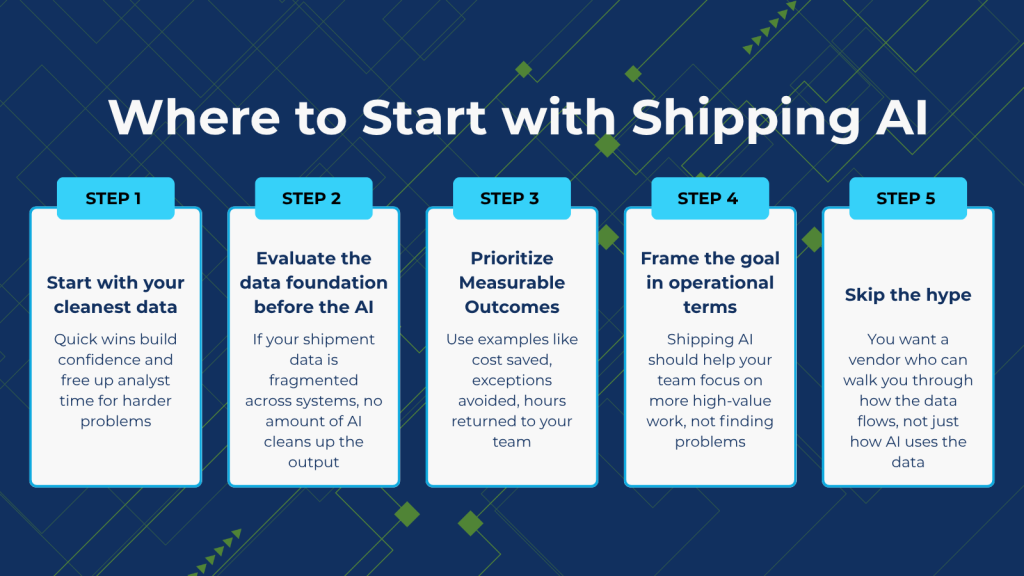
For shippers and 3PLs evaluating where to apply AI, five practical starting points cut through the noise:
- Start with your cleanest data. Parcel audit and rate shopping are common entry points because invoices and rate sheets tend to be more standardized than other shipping data. Quick wins build confidence and free up analyst time for harder problems.
- Evaluate the data foundation before the AI. If your shipment data is fragmented across systems, no amount of AI cleans up the output. Vendors who can demonstrate how they handle data ingestion, normalization, and ongoing quality are doing more for AI outcomes than vendors who lead with model specifications.
- Prioritize measurable outcomes. Cost saved, exceptions avoided, hours returned to your team. Anything vaguer is hard to evaluate and harder to defend when the renewal conversation comes up.
- Frame the goal in operational terms. Applicable shipping AI should help your team spend less time finding problems and more time solving them. The win is not a smaller team. It is a team focused on higher-value work.
- Skip the hype. If a vendor cannot show you the data inputs behind their AI, the model logic is not the issue. The data is. The clearest signal of mature shipping intelligence is a vendor who can walk you through how the data flows before they walk you through what the AI does with it.
Practical shipping AI is real; it is in product today and delivering measurable outcomes for shippers and 3PLs that approach it with the right expectations.