A practical framework for evaluating parcel performance, carrier strategy, and delivery execution after peak season.
Peak season shows where your shipping operation held up and where it broke down. It reveals whether your forecasts were realistic, whether your carrier strategy had enough flexibility, whether your systems kept pace, and whether your delivery experience stayed reliable under pressure. The teams that improve year over year are the ones that turn those findings into a clearer plan for the next peak season.
This guide gives shippers and 3PLs a structured way to review peak season performance using the metrics, questions, and decision points that matter most. It is built for teams that want to reduce guesswork, evaluate delivery performance with more confidence, and make smarter operational decisions before volume rises again.
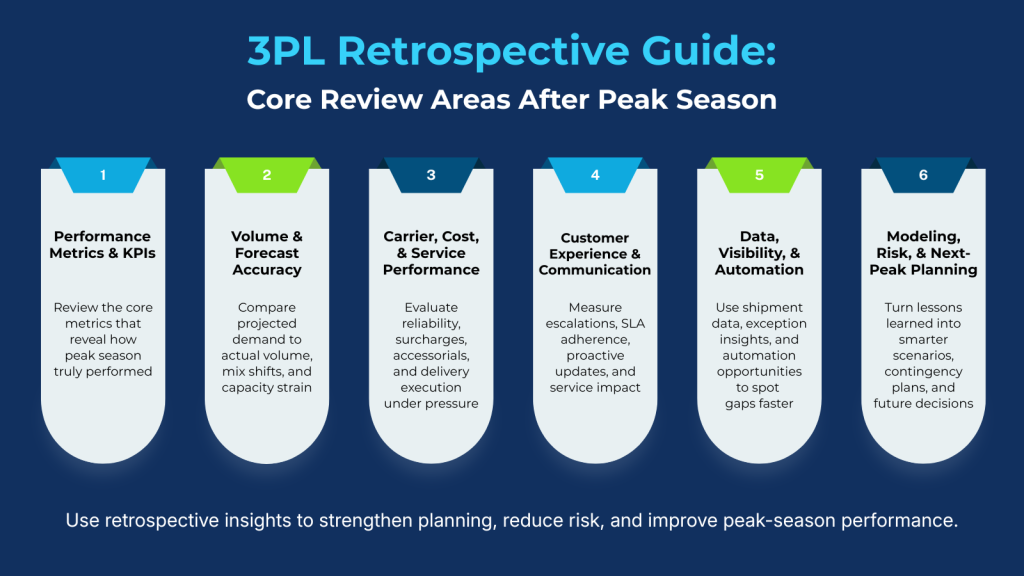
What Peak Season Revealed
Capture the Story of Your Season With Clarity and Context
A strong executive summary should give leaders a clear view of what happened during peak season and why it mattered. This section should quickly show how performance compared to expectations, where execution held up, and where cost, service, or visibility issues had the biggest impact.
At a high level, the summary should highlight:
- How actual shipment volume compared to the original forecast
- Which carriers supported service levels and which created added risk
- Whether systems, integrations, and exception workflows kept pace with volume
- Where shipping costs, surcharges, or DIM exposure affected margin
- Whether delivery performance or communication issues increased escalations
This section should stay high level, but it should not stay generic. Leaders should be able to understand what happened, why it happened, and which areas require deeper analysis. If you need a more detailed breakdown of the core metrics behind this review, start with The 10 KPIs Every 3PL and Shipper Should Measure After Peak Season.
Peak Season Volume Performance Analysis
Understand the Volume Patterns That Drove Your Best and Worst Days
Peak volume rarely follows a clean pattern. Promotions, product changes, channel shifts, and partner demand can all create sudden swings that affect shipping cost, carrier allocation, DIM exposure, and service performance.
A strong volume review should look at:
- Days where volumes exceeded your operational or carrier capacity
- Forecast deviation and how it influenced spend or staffing decisions
- SKU mix changes that altered dimensional weight or cartonization outcomes
- Channel shifts that increased B2C pressure or reduced B2B stability
Most organizations overestimate their forecasting model and underestimate how small inaccuracies compound across the network. A 5% forecast miss at the SKU level can translate into a 25% increase in last-mile cost due to cartonization inefficiencies.
Understanding the shape of your volume is more important than understanding the total. Did volume arrive in waves? Did it cluster around promotional peaks? Did it shift toward items with higher handling requirements? High performers use these insights to build adaptable workflows instead of rigid staffing plans and static carrier allocations. Modern modeling platforms help simulate these patterns long before peak begins, so your ceiling is built with real-world volatility in mind.
Carrier and Transportation Performance Review
Identify Which Carriers You Can Count On When It Matters Most
Peak season puts extreme strain on carrier networks. Capacity gets tight, service levels slip, regional constraints appear, and surcharges spike. Your transportation performance review helps you understand which partners truly supported your operation and where your network became vulnerable.
A strong carrier review should focus on a handful of core performance signals:
- On-time delivery performance across service levels
- Pickup reliability during your highest volume days
- Damage or loss patterns that increased cycle time and cost
- Surcharge trends and unexpected accessorial impacts
- DIM conversion frequency and the effect on total landed cost
- Regional carrier success versus national carrier performance
- Effectiveness of zone skipping and consolidation strategies
Too many organizations evaluate carriers based solely on contracted rates rather than total performance impact. During peak, the “cheapest” carrier often becomes the most expensive due to missed pickups, late deliveries, and avoidable accessorials. Transportation leaders are increasingly shifting toward scorecarding that blends cost, consistency, and risk. This is where multi-carrier enablement becomes strategically critical. When you can dynamically route based on performance signals or region-specific strengths, you reduce your dependency on any single carrier and improve service stability when demand spikes. Next-generation shipping systems support rules-based carrier selection that reflects real-world data, not static assumptions locked into a TMS.
Technology and System Performance During Peak Season
Evaluate Whether Your Systems Helped You Scale or Made Peak Harder Than It Needed to Be
Technology either amplifies your performance or restricts it. During peak season, system latency, poor integrations, and limited visibility can quietly erode your operational output even when your teams are performing well.
Start with the basics. Review system stability, carrier integration reliability, order-to-ship timing, tracking event completeness, exception detection speed, and communication workflow performance. Peak is often where small technical weaknesses become much easier to spot. A delay in tracking visibility, a failed carrier integration, or poor notification logic can ripple through service performance and internal response time much faster when volume is high.
The goal of this section is not to document every possible system issue. It is to determine whether your systems provided timely visibility, reliable automation, and usable data when pressure increased. The most valuable technology improvements are the ones that strengthen signal quality, reduce manual intervention, and make it easier to act before service problems get worse.
In peak conditions, a system issue that adds only 10 seconds to each shipment can translate into hours of lost throughput by the end of the day. Most teams underestimate how small technology inefficiencies expand under volume stress. Fragmented tech stacks, legacy shipping modules, manual carrier integrations, and outdated audit processes often show their cracks only during peak. Forward-thinking operations invest in platforms that deliver stable API throughput, multi-carrier redundancy, and proactive exception detection. Technology should provide visibility that moves faster than your volume, not slower. When your systems can keep pace, your team can shift from firefighting to foresight.
Client Service and Communication
Evaluate How Well You Protected the Customer Experience When Pressure Was Highest
Even the most efficient operations feel stress during peak. The real differentiator is how you protect the customer experience when volumes spike, carriers tighten, and exceptions increase. For shippers, this means maintaining delivery promises. For 3PLs, this means protecting client confidence and preventing escalations.
This section should review whether service issues were surfaced early, whether updates were timely, and whether exception workflows helped teams respond before problems spread. It should also consider whether address issues, failed delivery attempts, or disruption-related delays created a larger customer-service burden than expected.
A focused review might include:
- SLA adherence and escalation volume
- Resolution time for delivery issues
- Proactive communication performance
- Recurring causes of customer or client frustration
Customers and clients do not expect perfection during peak season, but they do expect clarity, honesty, and consistency. The real damage happens when organizations go silent or react too slowly when exceptions occur. Proactive communication is becoming one of the strongest predictors of customer retention in modern logistics. Brands that excel at experience often rely on automated, rules-based communication that informs customers before they reach out. This transforms peak from a period of reactive problem-solving into a period of predictable delivery experience. The best operators treat communication as part of their operational infrastructure, not an afterthought.
If your review needs to go deeper on service-level signals, retention risk, and delivery experience, read 3PL Customer Satisfaction Metrics to Monitor During the Shipping Process.
Peak Season Shipping Cost and Financial Performance Review
Identify Where Peak Protected Your Margin and Where It Eroded Profitability
Peak introduces cost volatility across labor, transportation, and operations. Understanding your financial performance at both the macro and micro levels helps identify where your margin held and where it weakened.
The clearest place to start is with cost per shipment trends. From there, review surcharge exposure, DIM weight impacts, billing accuracy, dispute resolution timing, and whether premium shipping services remained profitable during peak. Strong financial analysis should also separate one-time spikes from repeatable cost drivers so teams can distinguish true peak pressure from issues that were preventable.
Focus this section on a few questions:
- Which shipping costs rose fastest during peak?
- Which charges were volume-driven versus decision-driven?
- Where did poor visibility make costs harder to control?
- Which cost drivers are most worth fixing before next season?
Most financial surprises during peak are entirely preventable. They often stem from poor visibility into carrier billing behavior, rapidly shifting carton profiles, or unaccounted-for exceptions that quietly accumulate cost. High-performing shippers and 3PLs increasingly rely on continuous audit intelligence to surface discrepancies in real time rather than waiting for a quarterly review. The organizations with the strongest cost discipline invest in tools that turn their transportation budget from a black box into a monitored system. When cost accuracy becomes routine, peak stops being a gamble and starts becoming a predictable financial cycle.
To go deeper on cost leakage and margin erosion, explore Where Shippers Lose Revenue During Peak Season and How to Fix It.
Strategic Initiative Assessment After Peak Season
Measure Whether Your Investments and Strategies Delivered Real Impact
Peak season is the clearest test of your strategic planning. Improvements in forecasting, facility layout, carrier diversification, automation, labor strategy, and inventory placement all face real-world validation under pressure.
Not every initiative holds up under stress. Some changes reduce cost or improve service. Others add complexity without enough return. This section should help teams connect peak outcomes back to the decisions made before the season started, rather than treating results as isolated events.
A strong review asks simple but important questions. Did the initiative improve execution in a measurable way? Did it reduce risk, cost, or manual effort? Did it perform consistently across the network or only under certain conditions? Those answers help teams decide what to keep, what to refine, and what to stop carrying into the next planning cycle.
Risk and Contingency Review for Shippers and 3PLs
Measure How Fast You Responded When Something Went Wrong
Peak season disruptions are hard to avoid. What matters most is how quickly they were detected, how clearly teams responded, and whether the network had enough flexibility to adapt without creating wider service problems.
This section should review how the operation handled weather disruptions, carrier service failures, system issues, and other unexpected events. It should show whether teams had enough visibility to identify problems early and enough flexibility to make better routing or communication decisions once issues started to unfold.
A concise risk review should cover:
- How quickly disruptions were identified
- Whether fallback options were available and usable
- How effectively teams communicated and responded
- Which risks are most likely to repeat at the next peak
In practice, resilience comes from better data, better alerting, and stronger fallback options when normal execution starts to slip. A retrospective should make it easier to decide where contingency planning needs to improve before the next period of high demand.
Lessons Learned and Action Planning
Turn Your Insights Into a Clear, Accountable Plan for Next Year
A retrospective is only valuable if it changes behavior. This section should consolidate every insight into a realistic action plan with clear ownership and measurable outcomes.
The most impactful organizations treat action planning as an operational discipline rather than a post-peak ceremony. They track progress throughout the year and continuously refine their plan based on data. This transforms peak preparation from an annual scramble into a continuous improvement cycle that builds resilience over time. It’s how logistics teams shift from reactive operators to strategic partners inside the business.
This is also the right place to connect broader findings to tactical next steps. Teams that want a more structured way to organize follow-up actions can use the Post-Peak Season Checklist for 3PLs and Shippers as a practical companion to the retrospective.
Preparing for the Next Peak Season
Use What You Learned to Build a Smarter, More Predictable Plan
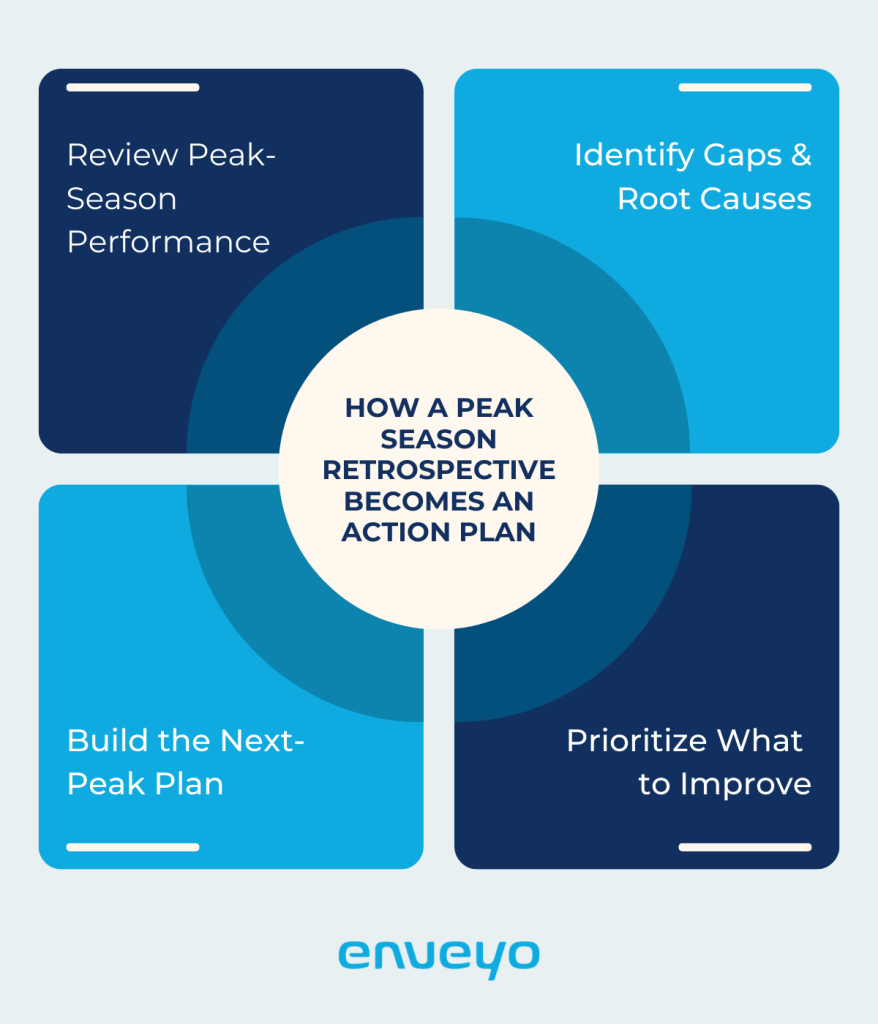
Once the analysis is complete, the next step is simple: use what you learned to improve the next peak plan. Preparation is stronger when it starts early, stays focused on real performance data, and prioritizes the decisions that have the biggest effect on cost, service, and visibility.
For some teams, that may mean improving forecast reviews or revisiting carrier allocation rules. For others, it may mean tightening exception workflows, reducing cost exposure, or strengthening communication practices before volume rises again. The exact priorities will vary, but the principle stays the same. The best post-peak reviews are those that directly inform better decisions before the next surge arrives.
Peak season rewards teams that can see performance clearly, respond quickly, and adjust with confidence. Shippers and 3PLs that improve over time are usually the ones that review the right data, challenge their assumptions, and build more flexibility into carrier strategy, visibility, and exception management before the next cycle begins.