Adoption of AI in shipping and logistics is no longer speculative. Gartner surveyed 140 senior supply chain leaders in late 2025 and found that 83 percent are applying AI incrementally to specific use cases or scaling it gradually into existing processes. Only 17 percent are redesigning their operations around it. That might look like hesitation, however read another way it looks like operations testing AI one problem at a time and keeping what works.
Enveyo calls that applicable AI: tools pointed at real operations problems rather than AI adopted for its own sake. The survey data suggest most shipping operations have arrived at the same conclusions through experience.
This guide organizes AI in logistics around the three outcomes it can actually be measured against: visibility, decisions, and delivery performance. For each one, it covers what AI genuinely improves, where it falls short, and where to go for more depth.
AI in logistics is a broad topic. It covers warehouse robotics, facility automation, and workforce planning alongside everything that happens in transit. This guide focuses on the shipping side: parcels, carriers, invoices, and deliveries.
Key Takeaways
- AI in shipping and logistics is best measured against three outcomes: visibility into shipments and spend, better carrier and service decisions, and improved delivery performance.
- Most adoption is incremental and use case specific rather than transformational, and the industry data supports that as the sensible path.
- The limiting factor is almost never the model. It is the fragmented, inconsistently named data underneath it.
- AI works best when it changes a decision a person would otherwise make by hand, and it needs a person in the loop to be trustworthy.
- The right evaluation question is not what a platform integrates with, but what methodology it uses to integrate at all.
Explore the Full Guide
- Explore real use cases across audit, carrier selection, and parcel optimization →
- Learn more about why the data foundation determines what the AI can deliver →
- Dive deeper into how prediction actually works, and where it stops →
- Discover what to look for when you are evaluating a platform →
What is AI in Shipping and Logistics?
AI in shipping and logistics is applied artificial intelligence used to interpret shipment data, surface operational patterns, and support carrier, service, and cost decisions across a shipping network. It is not a single capability. It is a set of tools doing different jobs on the same underlying data.
Four layers do most of the work. Machine learning handles prediction, estimating what is likely to happen based on what has happened before. Automated parsing and mapping handle ingestion, reading files from any carrier or system and normalizing them into consistent fields. Decision support handles recommendation, weighing cost and service tradeoffs at the shipment level. Alerting handles surfacing, pushing what needs attention to the person who can act on it.
AI in supply chain and logistics is the broader category covering sourcing, inventory planning, and manufacturing alongside transportation. AI in shipping and logistics is the transportation slice of that: the parcel, the carrier, the invoice, and the delivery. You will also see this territory called intelligent logistics, shipping intelligence, or AI-driven logistics. The labels vary more than the substance does. What matters is which problem the AI is pointed at, and whether that problem was worth solving in the first place.
How Does AI Improve Logistics Visibility?
AI improves logistics visibility by unifying shipment data that lives in separate systems, then surfacing what changed and what needs attention without requiring anyone to go looking for it.
The problem it solves is not a shortage of data. Most shipping operations are drowning in it. The problem is that no single view of it exists. Shipment records sit across carrier portals, an OMS, a WMS, a TMS, and finance systems, each with its own field names, its own refresh cadence, and its own idea of what a delivery exception is.
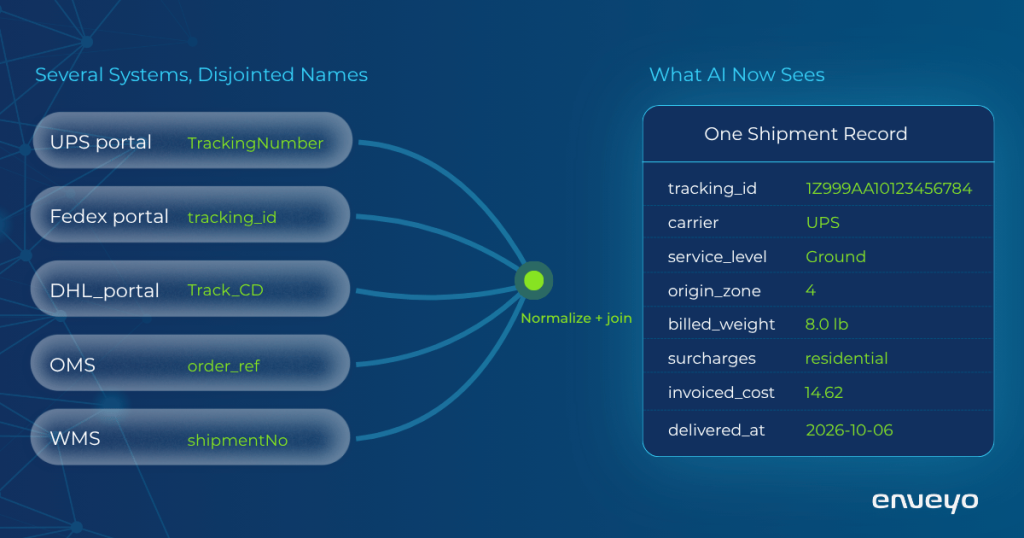
Visibility is knowing what is happening across your whole shipping operation at a level of detail that supports a decision. A tracking number tells you about one parcel. Logistics visibility tells you that your Tuesday volume on a particular lane has been arriving a day late for three weeks.
What Real-Time Visibility in Logistics Actually Requires
Three things have to be true before real time visibility in logistics means anything.
The data has to be reachable programmatically. A platform that holds your shipment data behind a manual export workflow can produce a report. It cannot produce a live view, and no amount of AI on top changes that.
The data has to be normalized across sources. If three carriers describe the same delivery event three different ways, a real-time feed only delivers the inconsistency faster.
The data has to be current enough to act on. This is where the term gets oversold. Real-time is only as real as the slowest feed in the chain. A dashboard refreshing every thirty seconds on carrier data that updates twice a day is not real-time visibility. It is a fast interface on stale information.
What Visibility Into Supply Chain Logistics Looks Like When the Data Is Unified
Once shipment data is joined and normalized, visibility into supply chain logistics resolves into three practical views.
- Shipment-level visibility answers where things are, which are at risk, and which have already missed a commitment. Not one parcel at a time, but across the operation, with the shipments that need attention separated from the ones that are fine.
- Spend visibility answers what you were charged, what you should have been charged, and where surcharges are concentrating. Invoices on their own tell you the first. Invoices joined to shipment context tell you the second, and that is where recovery opportunities live.
- Carrier and lane visibility answers how each carrier is actually performing by lane and service level, as distinct from what the service guide promises. That gap between promised and actual is where most contract renegotiation leverage comes from.
Where AI-Driven Visibility Breaks Down
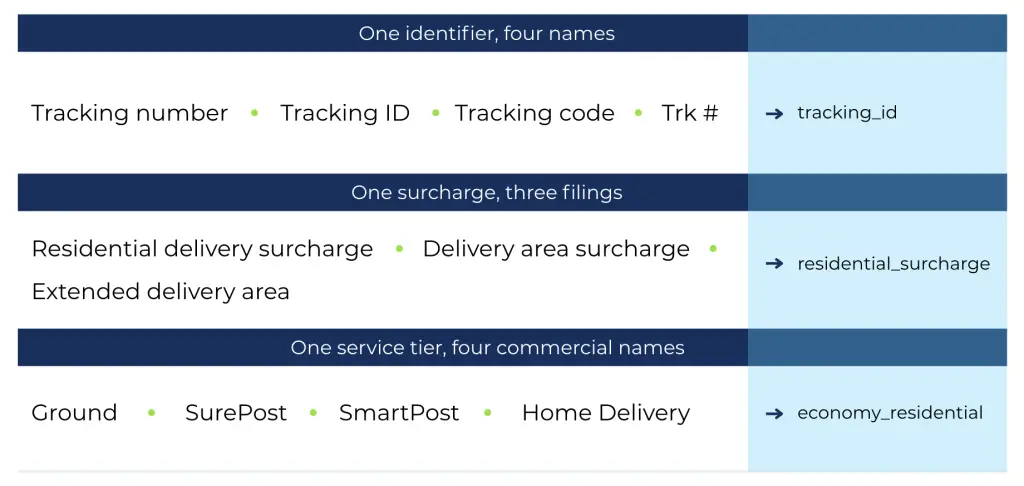
Fragmented naming hides patterns. When one carrier files a charge as a residential delivery surcharge and another files the same charge as a delivery area surcharge, one pattern splits into two smaller ones, and neither looks significant enough to act on.
Confident output on incomplete data is the most common failure. An interface reports what it found with the same certainty whether it saw all of your shipments or 60 percent of them. The gap does not announce itself, and teams usually discover it only after acting on the number.
Visibility tooling tends to expose the holes in your data before it makes your operation visible, and the first month often feels like bad news. It is not. It is the first accurate picture of something that was already true.
This is where Enveyo’s AI capabilities can do the heavy-lifting. When a file arrives from a source the system has not seen before, the AI reads it, identifies the fields that matter, and maps them to standard ones, returning a confidence score on each match rather than a silent guess. A person reviews and corrects what is wrong, and the system carries that correction forward the next time it encounters the same format.
How Does AI Improve Shipping and Logistics Decisions?
AI improves decisions in two distinct ways. Prediction estimates what is likely to happen. Automation acts on rules and models at a scale a person cannot match. They are different mechanisms with different failure modes, and knowing which one a vendor is describing tells you a great deal about what you are buying.
Prediction is what people usually mean when they say machine learning. It works on delivery and transit times, exception and delay risk, and volume by lane and service level, all questions where you have enough history for a pattern to be real. The boundary is firm. A model cannot predict something that has never happened in your data, and it cannot see outside your own operation. When conditions genuinely shift, a model trained on last year will not catch it on its own. The mechanics of how this works, and where it stops, get a fuller treatment in our guide to machine learning in the shipping industry.
Automation is the less discussed half and arguably the more useful one day to day. Carrier selection and rate shopping run per shipment against your own cost and service rules rather than a static default. Routing, labeling, and document handling move from manual steps to background ones. Parcel audit parses invoices and flags billing errors without anyone reviewing statements line by line.
The boundary is the same in both cases. Automation handles the repetitive decision. Prediction narrows the range of likely outcomes. A person still owns the judgment call and the exception, and that is the design rather than a limitation waiting to be engineered away.
How Does AI Improve Delivery Performance?
AI improves delivery performance by making performance measurable in the first place, then by catching the patterns that degrade it while they are still patterns.
On-time delivery rate, transit time variance, and exception rates are only as trustworthy as the data they are calculated from. When those numbers are assembled from partial sources, they are estimates presented as measurements, and teams make carrier decisions on them anyway.
What changes once the foundation holds is the timing of information. Senior leaders are not in a reporting platform daily, and that is not inattention. It is the job. The shift is that a degrading lane or a rising exception rate reaches someone while there is still room to act, rather than arriving as a customer escalation two weeks later. Dive deeper into how that data foundation translates into cost control and service performance.
AI does not make a carrier faster. It makes carrier performance visible and comparable enough that you choose differently next time, and negotiate differently at renewal.
What Are the Benefits of AI in Logistics, and Where Does It Fall Short?
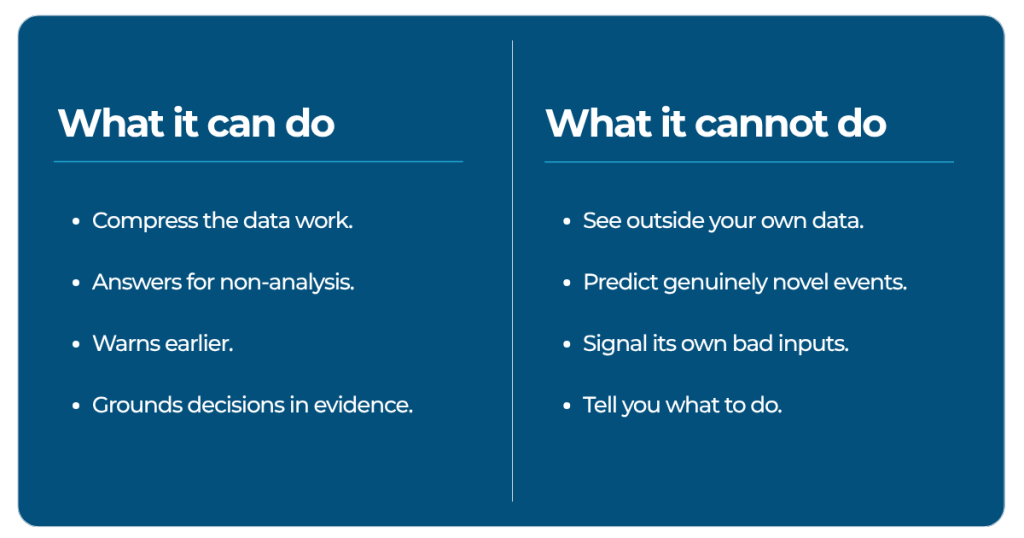
The benefits of AI in logistics are easiest to see when you describe them as time and attention rather than as features.
- Less time assembling data. Work that consumed days of analyst effort, pulling files from carrier portals and reconciling them into something comparable, compresses into a reviewed and validated process.
- Faster answers for people who are not analysts. Someone who knows the operation but not the data model can ask a question and get a usable dataset back, instead of waiting behind other requests in an analyst queue.
- Earlier warning. Patterns surface while they are still patterns, which is a materially different situation from finding them in a customer complaint or a quarterly review.
- Decisions made against evidence. Carrier mix, service level, and packaging choices get made from what your shipments actually did rather than from what the service guide claimed or what worked three years ago.
- The framing that matters here: the goal is helping people spend less time finding problems and more time solving them. Not a smaller team. A team pointed at higher-value work.
Now the other side, stated with equal directness.
AI cannot see outside your own data. Carriers protect their information, so your model learns from your operation’s history and nothing wider.
It cannot predict genuinely novel events. A pattern that has never appeared in your data is one no model can forecast reliably.
It produces confident output regardless of input quality. This is the most dangerous limitation, because nothing in the interface signals it. A polished answer on broken inputs is still a broken answer.
It cannot tell you what to do. A model can report that shipments from one region cost more per unit. Deciding whether to reroute, renegotiate, or absorb it remains a human judgment.
What Does the Future of AI in Logistics Look Like?
The near-term future of AI in logistics looks like continuity rather than rupture.
Gartner projects that 70 percent of large organizations will adopt AI-based forecasting to predict future demand by 2030. That is a significant shift in adoption, but it is a shift toward more of what already works: more automated data work, more proactive surfacing, more decisions supported by evidence instead of instinct.
The more useful prediction is about who benefits. The operations that get value from the next generation of tools will be the ones whose data foundation is ready when those tools arrive. Unifying and normalizing your shipment data is available to start now, and it is the same work that makes today’s tools worth using.
Where to Start With AI in Your Shipping Operation
Start where your data is already cleanest, which for most operations means parcel audit or rate shopping, because invoices and rate sheets tend to be more standardized than the rest. Ask vendors about their methodology for integrations rather than their list of integrations, since a list is a snapshot and a methodology tells you whether the foundation holds when your carrier mix changes. And judge any tool by whether it changes a decision you would otherwise make by hand. If it does not, it is a metric rather than a tool, however sophisticated the model behind it.
For the full evaluation framework, including what to ask about automation boundaries and confidence scoring, our guide to AI shipping management walks through it in depth.
If you want to see how these pieces connect on real shipping data, the Enveyo platform is built on the open data foundation this whole guide keeps returning to.
Frequently Asked Questions About AI in Shipping and Logistics
Automation follows rules you set: route this shipment this way, flag this charge over this threshold. AI adds pattern recognition on top, identifying things you did not know to look for and estimating outcomes based on history. Most shipping platforms use both, and the useful question when evaluating one is which parts are rules you control and which parts are model output you need to be able to inspect.
AI in supply chain and logistics is the broader category, covering sourcing, inventory planning, and manufacturing alongside transportation. AI in logistics, used in the shipping sense, focuses on the transportation side: parcels, carriers, invoices, and deliveries. The distinction matters when evaluating vendors, because platforms built for one are not always suited to the other.
Ask about their methodology for integrations rather than their list of integrations. Ask what is automated versus what still requires a person, and how the system reports its own confidence when it is uncertain. Ask what happens when your carrier mix or file formats change in six months. Our guide to AI shipping management covers the full evaluation framework.
Rarely, and the honest answer depends on your slowest data source. A platform can refresh its interface every few seconds, but if a carrier feed updates twice a day, the underlying picture is twelve hours old regardless of how the dashboard behaves. Ask vendors about update frequency per data source rather than about the refresh rate of the display.
No. The pattern in practice is a shift in where analyst time goes, not a reduction in it. The manual work of pulling and reconciling data compresses, and the time moves toward interpreting findings and acting on them. AI can identify that a lane is degrading. Deciding whether to reroute, renegotiate, or absorb the cost still requires someone who understands the business relationship behind that lane.
Start by mapping where shipment data currently lives across your carrier portals, OMS, WMS, TMS, and finance systems, and where those sources fail to connect. If the same shipment appears differently in different systems, or if surcharges and service levels are named inconsistently across carriers, that reconciliation work comes first. It is also the work AI is genuinely good at, which is why data mapping is one of the most mature applications in shipping today.